Falsified Civic Will and Political Legitimacy
The LeopardThe plebiscite at Donnafugata exposes the distance between an official claim of unanimous consent and the choices residents actually made. Its declared result—512 votes in favour and none against—turns out to conceal opposition, including Don Ciccio Tumeo’s erased ballot. For Don Fabrizio Corbera, Prince of Salina, the decisive injury is not that the vote’s arithmetic altered the outcome, but that the new political order began by denying citizens’ good faith and making their will appear to be its own.
Political Consent Before the Vote
The vote takes place as the Kingdom of the Two Sicilies gives way to a new national order. Don Fabrizio has urged residents who seek his counsel to vote in favour, reasoning that acceptance is necessary whether the change is treated as historical fact or political theatre. Yet he does not mistake advice for proof of consent. He has seen that some visitors interpret his recommendation as irony, while others distrust the change or resist it for religious, personal, or material reasons. From those who approach him he estimates that roughly fifteen may vote against; allowing for the many electors who never visit the palace, he expects about forty dissenting ballots in the town.
The uncertainty is characteristic of a society where political judgment is filtered through rank and personal dependence. Some residents assume a prince cannot sincerely endorse revolution; others suspect that his words conceal their opposite. Don Fabrizio’s counsel therefore produces no simple measure of conviction. It is received through inherited habits of deference and suspicion, leaving private judgments difficult to distinguish from public compliance.
The preceding political order supplies a contrast. At court, King Ferdinand’s familiar manner shifts into sovereign authority when he asks Don Fabrizio for information about Sicily; Don Fabrizio avoids serving as an informant. On leaving, he wonders whether a successor government based in Turin would differ substantially from the Neapolitan monarchy. Later, Don Calogero Sedàra’s assurances that the new authorities will respect Don Fabrizio’s household likewise present political security through personal connections. These episodes frame the plebiscite not as a clean break from personal rule, but as a moment when older loyalties and emerging institutions overlap.
The Public Ritual and Its Official Arithmetic
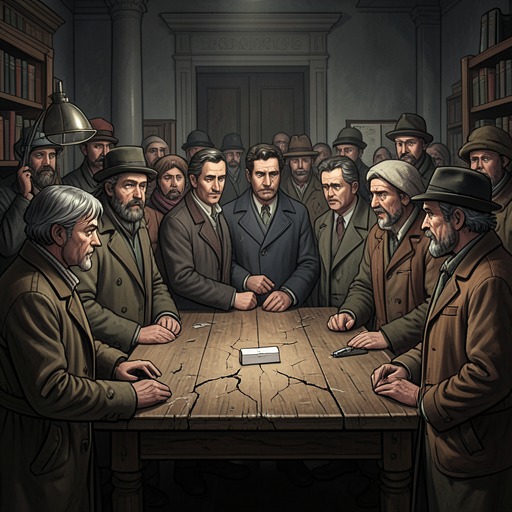
On voting day, the town’s outward signs of unanimity coexist with a more complicated atmosphere. Young men carry scraps marked in favour and sing in the streets. Visitors from Girgenti proclaim a progressive future, while peasants listen without speaking. The Prince arrives at the Town Hall in the afternoon with Father Pirrone and Don Onofrio Rotolo. His presence changes the procedure: committee members rise, and peasants who had arrived earlier are moved aside so he can vote without waiting. He places his affirmative ballot in the hands of Don Calogero, the mayor. Father Pirrone does not vote, having avoided registration as a resident; Don Onofrio casts his own affirmative vote at the Prince’s express request.
The announcement later that night makes the new political order’s claim to consent unmistakable. Don Calogero appears on the Town Hall balcony and reports 515 voters, 512 votes cast, 512 in favour, and none against. The published tally makes the result look complete even though three fewer people voted than were counted as voters, and it leaves no recorded opposition at all. The official figures do not merely describe the vote: they present a political reality in which dissent has no visible place.
The ceremony extends beyond the numbers. The Mayor’s room contains portraits of Garibaldi and King Victor Emmanuel, displayed together as symbols of the new order. Red, green, and white glasses of rosolio evoke the national flag; speeches and celebrations follow the announcement. The arrangement turns administrative reporting into public ritual, joining symbols of national unity to a result that appears to confirm it. Yet the festivities cannot establish whether the people represented by the figures actually agreed.
The Erased Ballot
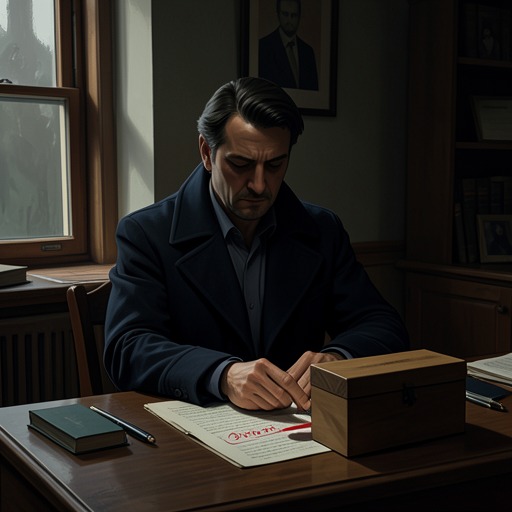
Don Ciccio’s disclosure breaks the appearance of unanimity. He tells Don Fabrizio that he voted against the measure and that the Town Hall transformed his choice into an affirmative vote. His account gives a concrete instance of what the tally had concealed: a citizen’s expressed judgment did not enter the official record as he cast it. The fraud is personal as well as political. Don Ciccio insists that he is an honest man, identifies himself through his family and work as organist of Donnafugata’s Mother Church, and resents being treated as though his vote and person counted for nothing.
His opposition is rooted in attachment to the former monarchy as well as distrust of the new order. He recalls assistance his family received from the royal court, including five gold ounces that helped them through a difficult winter, and remembers his father’s service and recognition under the old regime. He understands that such royal gestures may have belonged to the work of government, but their material effect and the family’s experience of loyalty remain real to him. The change in political language—from faithful subject to a suspect supporter of the Bourbons—makes him feel that his history has been recast along with his vote.
The episode also reveals how social position shapes the experience of consent. Don Ciccio contrasts the Prince’s relative independence with the dependence of poorer people, who may have to accept what powerful figures decide. Don Fabrizio had previously heard similar confidence in the new order from Don Pietro Russo, who expected liberty, lighter taxes, and opportunity while privately seeking to buy the Prince’s estate at Argivocale. Such exchanges suggest that promises of political improvement coexist with local calculations of property, influence, and protection. The formal vote is therefore entangled with relationships that can make public choice difficult to separate from dependence.
Legitimacy, Good Faith, and Consequence
Don Fabrizio’s response is a recognition that the deeper loss is good faith. He believes the dissenting votes could not have changed the result; indeed, recording them might have made the affirmative outcome more credible. Their suppression instead damages the moral basis on which the new state seeks recognition. The old regime’s direct commands, he reflects, have given way to a subtler pressure in which a person’s apparent agreement can be used to claim that the person has freely consented. Authority changes its language, but the citizen’s independent will remains vulnerable.
The Prince’s judgment does not amount to a simple defence of the Bourbon monarchy. He had advised residents to vote in favour and recognizes the political necessity of national unity. His unease arises because an outcome he can accept has been made less legitimate by the means used to produce it. The distinction between the result and the process is central: the falsification was unnecessary to secure the result, yet it made the public record a denial of what at least some electors had chosen.
After the disclosure, Don Fabrizio’s regard for Don Ciccio deepens. He has long felt sympathy for the organist’s dignity and frustrated artistic aspirations; now he also wonders whether Don Ciccio has acted more honourably than the Prince himself. The contrast unsettles the social hierarchy between them. Don Ciccio, poor and dependent, has preserved the integrity of his choice, while the Prince, who counselled a yes vote, must confront the cost of a process that erased a no.
The narrative gives the falsified ballot consequences beyond Donnafugata. It presents the annulment of this early expression of liberty as one cause of the political slackness and acquiescence later attributed to people in the South. The official declaration may close the count, but it cannot restore the trust that the manipulation has spent. In this account, political legitimacy depends not only on which side wins, but on whether the losing choice is allowed to exist in the public record.